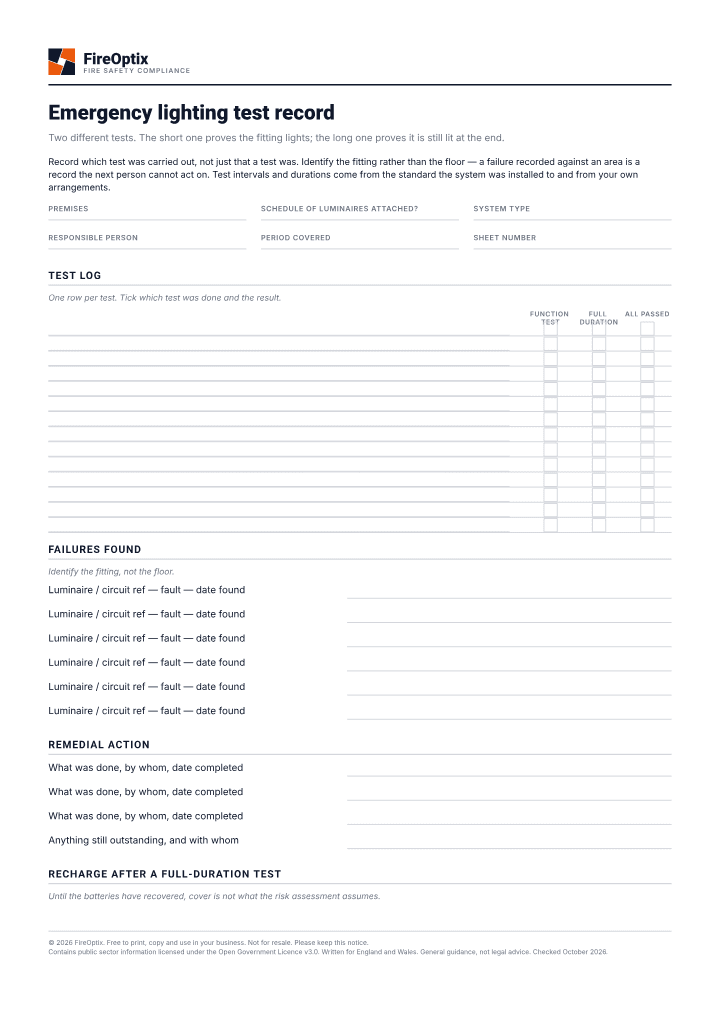
Emergency lighting test record. A printable log for emergency lighting tests, separating the short function check from the full-duration test and recording which luminaires failed.
This is the paper version. FireOptix does the same job on a phone, with the record filed against the building or the asset automatically.
What is on the sheet
- A row per test with the date, the type of test carried out and who carried it out
- Circuit or luminaire reference, so a failure points at a fitting rather than at a floor
- Separate columns for the short function check and the full-duration discharge test, because they prove different things
- Whether the luminaire illuminated, stayed illuminated for the period set for the test, and recharged afterwards
- Failures, with the fitting identified and the remedial action and date it was put right
- A recharge-period note, so the building is not left with discharged batteries and no record of when they will be ready
Why this record matters
Emergency lighting has two tests that are often run together and should not be. The short one proves the fitting switches to its battery and lights up. The long one proves it will still be lit at the end of the period the system was designed for. A log with one column cannot tell you which of those was done, and a building where only the short test has ever been run has never proved the thing that matters.
Identifying the fitting is the other half. 'Second floor — one failure' is a record that the next person cannot act on; a luminaire reference is a record that sends somebody to a ladder. The sheet asks for the reference and leaves room for a schedule of fittings to be attached.
Durations and intervals are deliberately absent. What the full-duration test has to achieve depends on what the system was designed and installed to — which varies with the premises and the escape routes in it — and the testing regime comes from BS 5266 and the building's own arrangements rather than from a free sheet. The columns record which test was done and whether it passed.
The recharge note is there because a full-duration test leaves the batteries flat. Until they have recovered, the building's emergency lighting is not what the risk assessment assumes it is, and that is worth a line on the record rather than a thing everybody knows.
Use it with
- Weekly fire alarm test recordA printable log for the routine fire alarm test — which call point was used, whether the sounders were heard everywhere, and what was wrong if anything was.
- Escape route inspection checklistA printable walk-the-route checklist for escape routes and final exits — clear, openable, lit, signed and free of the storage that accumulates in corridors.
- Fire log bookA printable fire log book: a cover, an index of what belongs in it, and record pages for the tests, services, drills, training and findings that make up a premises' fire safety history.
- Fire safety audit checklistA printable audit checklist for checking that fire safety management is actually happening — the records, the testing, the training and the open actions — as distinct from assessing the risk itself.
Read more on this
© 2026 FireOptix. Free to print, copy and use in your business. Not for resale. Please keep this notice.
Contains public sector information licensed under the Open Government Licence v3.0. Written for England and Wales. General guidance, not legal advice. Checked October 2026.