Personal emergency evacuation plan (PEEP). A printable PEEP form for recording how a person who could not evacuate unaided will get out, what help they need and who is providing it.
This is the paper version. FireOptix does the same job on a phone, with the record filed against the building or the asset automatically.
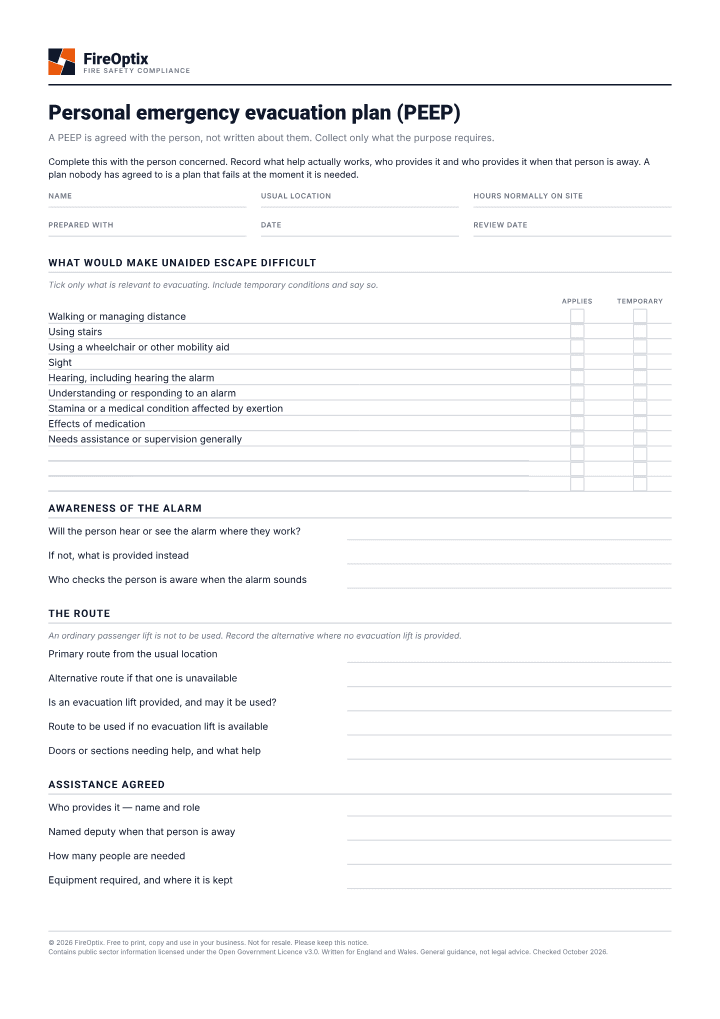
What is on the sheet
- The person's details, their usual location and the hours they are normally in the building
- What would make unaided escape difficult — mobility, sight, hearing, cognition, stamina, medication or a temporary injury
- Whether the person will be aware of the alarm, and what is needed if not
- The route, including lifts where an evacuation lift is provided and the alternative when it is not
- The assistance agreed: who provides it, how many people, what equipment, and who is the named deputy
- Use of a refuge where the building has one, how the person communicates from it, and a review and agreement block signed by the person themselves
Why this record matters
A PEEP exists because a general evacuation strategy assumes people can use it. Where someone cannot — permanently or for the next six weeks on crutches — the plan has to be made in advance with that person, not improvised by whoever is nearest when the alarm sounds.
The form is written to be filled in with the person rather than about them. That is why the agreement block is signed by them: a plan somebody has not agreed to is a plan that fails at the moment it is needed, and the person is the only reliable source for what help actually works and what is unwelcome.
Two things are commonly left off. The first is the deputy — an assistance arrangement that names one colleague fails the day that colleague is on leave. The second is what happens when the lift is not an evacuation lift, which is most lifts; the sheet asks for the alternative explicitly rather than leaving a route that cannot be used.
Refuges are recorded as what they are: a place to wait in relative safety with a means of communication, not a destination. Where the building has one, the sheet asks how the person calls for help from it and who is expected to answer.
Use it with
- Fire risk assessment templateA printable fire risk assessment form, covering the premises, the people at risk, the hazards, the fire safety measures already in place and the significant findings that come out of it.
- Fire drill recordA printable fire drill record covering the scenario, the routes used, how the evacuation actually went, what went wrong and what was changed as a result.
- Fire warden duties checklistA printable record of who the fire wardens are, which areas they sweep, what they are expected to do on the alarm and what training they have had.
- Escape route inspection checklistA printable walk-the-route checklist for escape routes and final exits — clear, openable, lit, signed and free of the storage that accumulates in corridors.
Read more on this
© 2026 FireOptix. Free to print, copy and use in your business. Not for resale. Please keep this notice.
Contains public sector information licensed under the Open Government Licence v3.0. Written for England and Wales. General guidance, not legal advice. Checked October 2026.